


Table of Contents
Email marketing remains one of the highest-ROI channels available to businesses of any size — but only if you’re using a platform that actually fits how you work. The right tool should make it easy to design campaigns, grow your list, automate the boring stuff, and see what’s actually working. The wrong one just adds friction.
We tested and compared the top email marketing platforms on the market in 2026, looking at free plans, automation depth, templates, and deliverability. Here’s what we found.
This article was last updated in 2026.
The 10 best email marketing platforms
1. MailMarketer— Best overall for growing businesses
2. HubSpot— Best for enterprise marketing teams
3. Mailchimp — Best for simple, no-fuss emailing
4. Klaviyo— Best for ecommerce automation
5. ActiveCampaign — Best for advanced automation workflows
6. Postyman — Best for solo senders and basic newsletters
7. GetResponse — Best for webinars and funnels
8. MailerLite— Best customer support
9. AWeber — Best for bloggers
10. EmailOctopus — Best simplicity on a budget
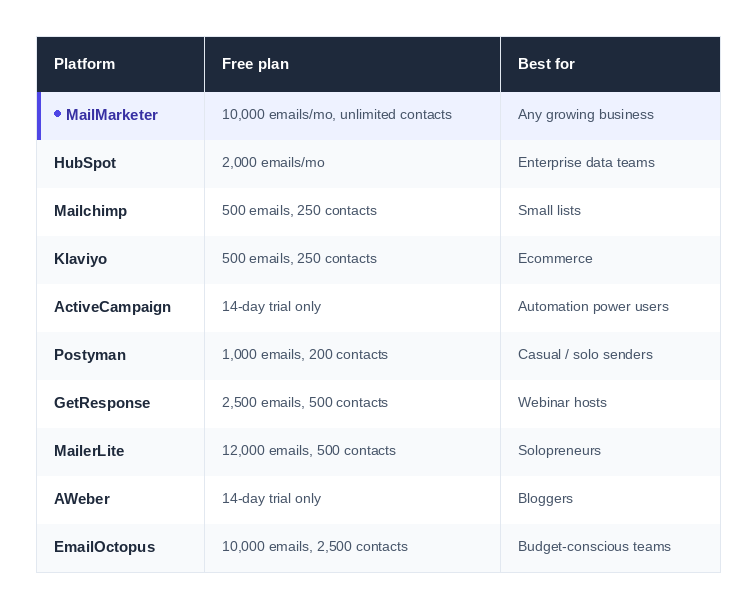
At a glance: comparing the top picks
What makes a great email marketing platform?
Before diving into the list, here’s what we weighed when ranking each tool:
Free plan value— generous contact and send limits, not just a watered-down trial.
Ease of use— a drag-and-drop builder that doesn’t require a design background.0
Automation depth— multi-step, condition-based workflows, not just single triggers.
Deliverability— strong sending infrastructure so your emails land in the inbox.
Scalability — room to grow without switching tools or facing punishing price jumps.
Integrations — easy connections to the rest of your stack (Shopify, WordPress, CRMs, etc.).
1. MailMarketer — Best overall for growing businesses
MailMarketer is built around one idea: powerful email marketing shouldn’t require a learning curve or an enterprise budget. It combines a clean drag-and-drop editor, ready-to-use templates, and automation that’s genuinely usable on the free plan — not locked away until you upgrade.
Standout features:
– Drag-and-drop editor with brand kit support (save your logo, colors, and fonts once, reuse everywhere)
– Visual automation builder with pre-built recipes for welcome series, abandoned carts, and re-engagement
– Smart segmentation based on behavior, engagement, and custom fields
– Built-in send time optimization
– AI-assisted subject lines and copy suggestions
– Real-time analytics with click-heatmaps
2. HubSpot — Best for enterprise marketing teams
HubSpot is less a standalone email tool and more a full marketing and sales operating system. Email lives inside the broader Marketing Hub, alongside landing pages, lead scoring, and CRM data — which makes it powerful for teams that need everything connected, but heavy for anyone who just wants to send a newsletter.
3. Mailchimp — Best for simple, no-fuss emailing
Mailchimp remains a go-to starting point for beginners thanks to its intuitive interface and recognizable template library. It covers the essentials — A/B testing, segmentation, automation — without overwhelming new users.
4. Klaviyo — Best for ecommerce automation
Built specifically for online stores, Klaviyo ties directly into platforms like Shopify and WooCommerce to power highly targeted, revenue-driving campaigns based on real purchase and browsing behavior.
5. ActiveCampaign — Best for advanced automation workflows
ActiveCampaign is built for marketers who want granular control over every customer journey. Its automation builder supports complex branching logic, lead scoring, and a built-in CRM to keep sales and marketing aligned.
6. Postyman — Best for solo senders and basic newsletters
Postyman is a lightweight option aimed at individuals and very small teams sending straightforward newsletters. The interface is simple and the setup is fast, though it trades away depth for that simplicity — automation is limited to single-step triggers, and there’s no built-in segmentation beyond basic tags.
7. GetResponse — Best for webinars and funnels
GetResponse stands out for bundling webinar hosting and full sales funnel building alongside its email tools — a strong fit for businesses that lean on live events and structured launches to drive sales.
8. MailerLite — Best customer support
MailerLite pairs a generous free plan with consistently well-reviewed customer service, making it a favorite among solopreneurs and freelancers who need help fast when something goes wrong.
9. AWeber — Best for bloggers
AWeber leans into content creators and bloggers with an AI design assistant that builds on-brand templates from your existing website or social presence, plus a large template library to start from.
10. EmailOctopus — Best simplicity on a budget
EmailOctopus keeps things deliberately simple: a clean editor, reliable sending, and an approach that doesn’t punish you for growing your list — a solid choice for teams that don’t need every bell and whistle.
Which platform should you choose?
If you want a platform that grows with you without forcing a switch later, MailMarketer is built to cover the full journey — from your first newsletter to multi-step automated campaigns — without the feature gates common elsewhere on this list. Tools like Postyman or EmailOctopus make sense if you’re sending very simple, low-volume newsletters and don’t need much automation, while HubSpot or Klaviyo fit teams with more specialized needs (deep CRM integration or ecommerce-specific automation, respectively).
The best move is usually to start on a free plan, send a few real campaigns, and see how the automation and reporting hold up against your actual workflow — not just the feature list.