

You’ve spent countless hours perfecting your product and crafting brilliant marketing campaigns. A customer is excited, they’re on your website, and they click “Buy Now” or “Sign Up.” This is the moment of truth. An order confirmation is supposed to hit their inbox instantly. A welcome email should appear. A password reset link should arrive without delay.
But what if it doesn’t?
This is the hidden problem many businesses underestimate: the failure of transactional emails. These aren’t your typical newsletters; they are critical, expected communications. When they fail, the damage isn’t just a missed message—it’s a broken customer experience that can erode trust and cost you revenue.
The Hidden Problem: Most Businesses Underestimate Transactional Emails
Transactional emails are the backbone of modern customer interaction. They are automated, one-to-one messages triggered by a user’s action or a specific event. Unlike marketing emails, which are sent in bulk to a list, transactional emails are personal and anticipated.
Think about the last time you:
- Reset a password.
- Received an order receipt.
- Got a shipping notification.
- Verified your account with a one-time password (OTP).
You didn’t just hope for those emails; you expected them. Instantly.
What Goes Wrong When Critical Emails Fail to Deliver?
Using a standard email provider or a basic marketing platform for these crucial messages is a recipe for disaster. These systems aren’t built for the speed and reliability that transactional emails demand.
When they fail, you face:
- Customer Frustration: A user locked out of their account because a password reset email never arrived is an angry user.
- Increased Support Tickets: When an order confirmation goes missing, your support team gets flooded with “Did my order go through?” inquiries.
- Lost Revenue: A customer who doesn’t receive their purchase receipt may worry they’ve been scammed, leading to chargebacks and abandoned future purchases.
- Security Risks: An OTP email that is delayed or lands in spam can prevent a user from logging in securely, undermining their trust in your platform.
These aren’t just emails; they are fundamental promises your business makes to its customers.
The Solution: A Dedicated Transactional Email Service
To guarantee these messages arrive in the inbox every single time, you need a dedicated transactional email service. Platforms like MailMarketer are specifically engineered for this task.
Here’s why it makes a difference:
- Superior Deliverability: We use high-reputation IP addresses and authentication protocols (like SPF, DKIM, and DMARC) to ensure your emails bypass spam filters.
- Blazing-Fast Speed: Our infrastructure is optimized to send emails in milliseconds, not minutes.
- Developer-Friendly APIs: Easily integrate our service into your app or website for seamless, automated communication.
- Detailed Analytics: Track delivery rates, opens, and clicks to ensure your system is running smoothly.
Core Transactional Use Cases No Business Can Ignore
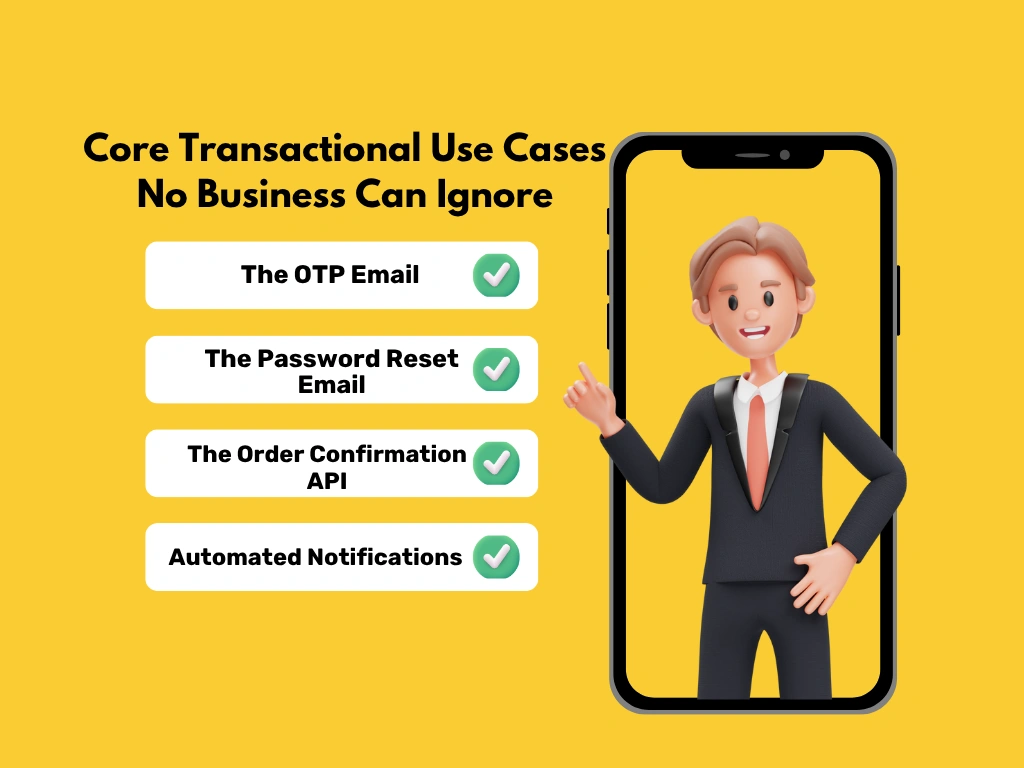
Let’s break down the most common types of transactional emails and why they are so critical.
1. The OTP Email: Your Digital Gatekeeper
A One-Time Password (OTP) is often the first interaction a user has with your security system. It must be immediate and reliable.
Best Practice: Use a service that guarantees near-instantaneous delivery to maintain a frictionless and secure user experience.
Scenario: A user tries to log into their financial services app. The app sends an OTP email to verify their identity. If that email is delayed by even 60 seconds, the code expires, the user is locked out, and their confidence in your security plummets.
2. The Password Reset Email: A Lifeline for Your Users
Forgetting a password is a universal experience. The process of resetting it should be painless.
- Scenario: A long-time customer returns to your e-commerce store but can’t remember their password. They request a reset link. If the password reset email lands in spam or never arrives, you haven’t just lost a sale—you may have lost a customer for good.
- Best Practice: Ensure your reset emails have a clear subject line (e.g., “Reset Your [Your Brand] Password”) and a simple, single call-to-action button.
3. The Order Confirmation API: Sealing the Deal
After a customer makes a purchase, their anxiety is at its peak. The order confirmation is the exhale—the proof that their transaction was successful and their order is being processed.
- Scenario: A customer buys a gift for a special occasion. They complete the checkout, but no confirmation email arrives. They start to worry. Did the payment fail? Did they type their email wrong? Using an order confirmation API from a service like MailMarketer allows your e-commerce platform to automatically trigger this email the second the purchase is complete.
- Best Practice: Include all essential details in the confirmation: order number, items purchased, total cost, shipping address, and an estimated delivery date. This single email can prevent a support ticket.
4. Automated Notifications: Keeping Customers in the Loop
Automated notifications cover a wide range of triggered messages that enhance the customer experience by providing timely information.
Examples:
- Shipping Updates: “Your order has shipped!”
- Account Alerts: “A new device has logged into your account.”
- Welcome Emails: “Welcome to [Your Brand]! Here’s how to get started.”
- Digital Invoices & Receipts: A record of payment for services.
Scenario: A SaaS customer’s subscription is about to renew. An automated notification reminds them, preventing a surprise charge and potential churn. These small, proactive communications build immense trust.
How Reliable Delivery Protects Your Brand
Every successfully delivered transactional email reinforces your brand’s reliability. It tells your customer:
- “We are professional.”
- “Your information is safe with us.”
Conversely, every failed email plants a seed of doubt. In a competitive market, you can’t afford to have your core communications fail.
Quick Implementation Checklist
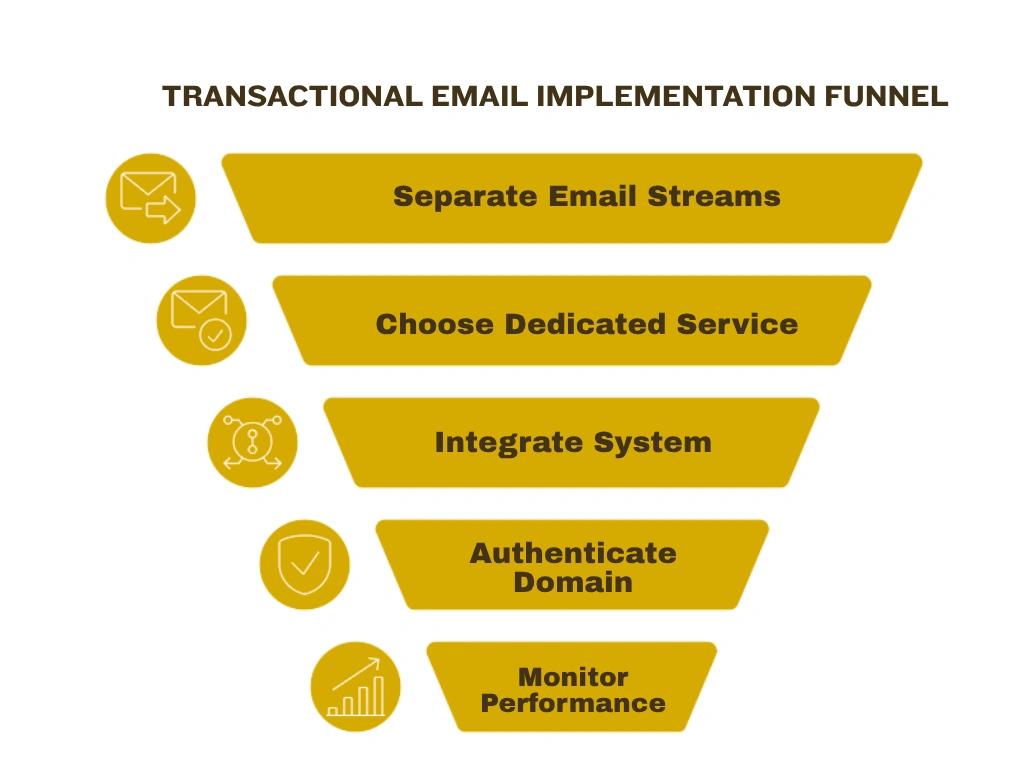
Ready to improve your transactional emails? Here’s where to start:
- Audit Your Triggers: Identify every action on your site or app that should send an email (e.g., sign-up, purchase, password request).
- Separate Your Email Streams: Never send transactional messages through your bulk marketing platform.
- Choose a Dedicated Service: Sign up for a reliable transactional email service built for deliverability and speed.
- Integrate via API or SMTP: Have your developer connect your system to the service for automated sending.
- Authenticate Your Domain: Set up SPF and DKIM records to prove to inbox providers that your emails are legitimate.
- Monitor and Analyze: Use the dashboard to track your delivery rates and ensure everything is working perfectly.
Conclusion: Don’t Leave Your Most Important Emails to Chance
Transactional emails are more than just automated messages; they are a critical part of your customer journey, your security infrastructure, and your brand’s reputation. Underestimating their importance is a silent business killer.
By switching to a powerful and reliable service, you ensure that these crucial touchpoints build trust, reduce customer support load, and create a seamless experience that keeps users coming back.
Ready to take control of your transactional emails?
Sign up for MailMarketer today and ensure your most important messages are delivered, every single time. Our powerful API and robust infrastructure are ready to support your business at any scale.